

More about me
For nearly five years I lived in Egypt. Not visited — lived. I studied at the American University in Cairo, where I took a master's in public policy and international human rights law and wrote on the right to education in Egyptian primary schools. I worked there. I learned the country at the pace you only learn a place when you have to renew a residency, argue with a landlord, and form an opinion about which bridge to avoid at six o'clock.
I still spend roughly a third of every year in Egypt. It stopped being a trip a long time ago.
I do not claim to have finished learning Egypt. I claim to be in the middle of it — still asking, still being corrected by people who know more than I do.
What I can offer travellers is the difference between visiting a country and being answerable to it.
The through-line, if there is one, is education. A master's on the right to schooling in Egypt, a doctorate in education, years building educational travel, and now a professorship at Barnard. Composing a journey turns out to be the same discipline as composing a course: sequence matters, context matters, and nothing of consequence is learned at a sprint. It is why the days are ordered the way they are, why there is an unscheduled afternoon every third day, and why you will be told what you are looking at and why it matters before you are standing in front of it.
I founded The Curated Passport because the Egypt available to most travellers is assembled from what other people have already said about it — the same five sites, the same photograph, the same hour of the morning. That version is not wrong. It is thin, and it is not the country I lived in.
What I offer instead is Egypt as I have come to understand it: from inside a family's house in Gharb Soheil, from a temple at the hour it belongs to no one, from the seat of someone who has lived on both sides of the water and spent a long time paying attention.

Nubia
Aswan is not a stop between Luxor and Abu Simbel.
My family is Nubian, from Aswan. That is not a line of biography I mention in passing — it is the reason this company exists in the shape it does. Nubia has its own language, its own architecture, its own kings and reigning queens, and a history that most Egypt itineraries reduce to an afternoon.
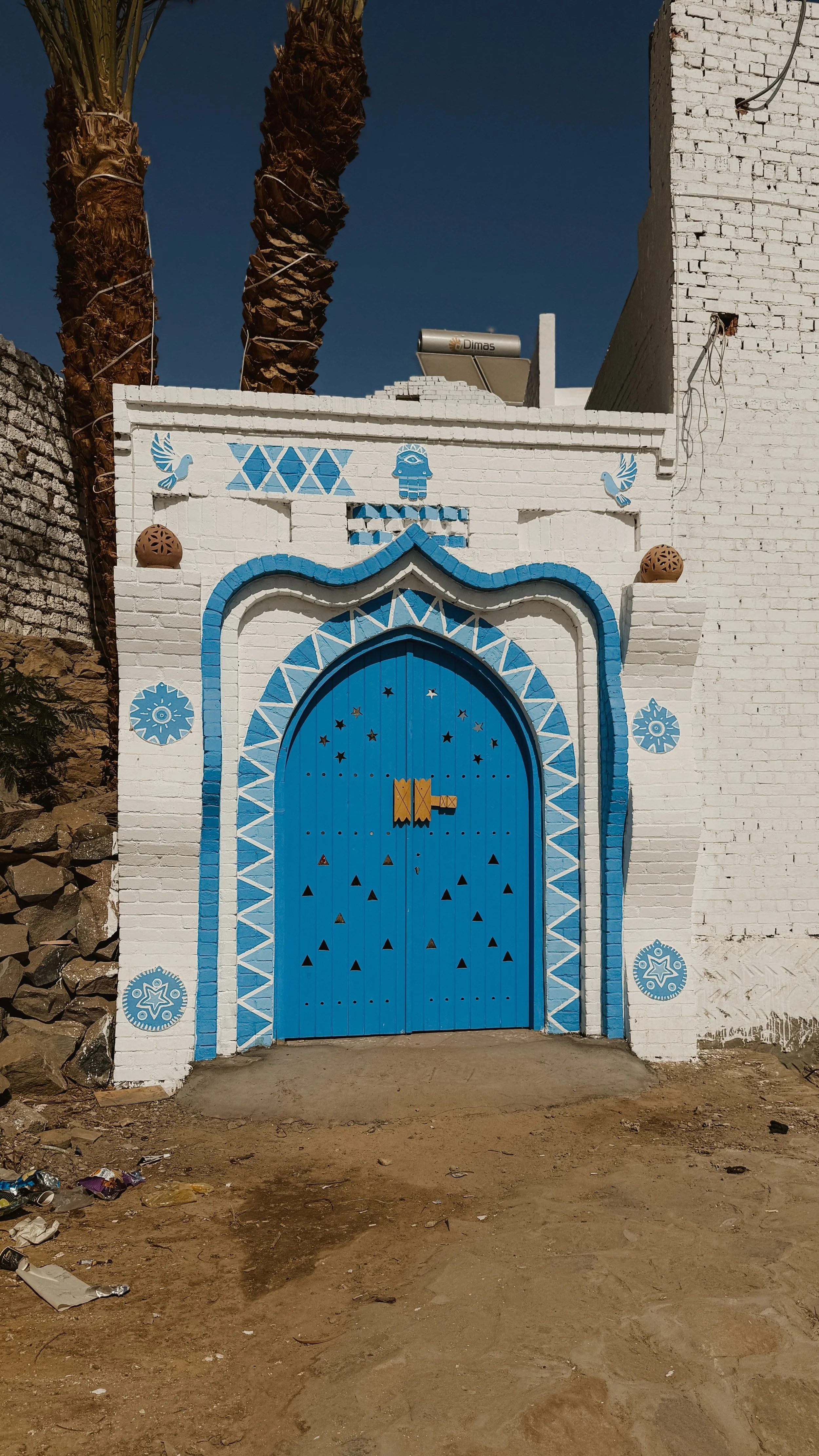
The houses are vaulted to catch the wind. Plates are set into the façades. The doorways are painted before the walls are finished, because the door is the part of a house that receives people.
When the High Dam was built, tens of thousands of Nubians were displaced and dozens of villages went under the water. That history sits underneath every journey I run, and it is the subject of research I am still doing — preservation of the Nubian culture and language — which means what I tell you standing on a riverbank is history I am also accountable for in print.
The mark
Three vaulted domes and a doorway, drawn from the Nubian houses of Gharb Soheil and Elephantine. The triangles echo the geometric band painted around the threshold. The colours — lapis, carnelian and gold — are the three stones set side by side in Egyptian jewellery for four thousand years.
Who you travel with
I host two departures a year. These are the people who run the rest.
Every journey — hosted, guided or private — runs with the same Egyptologists, the same drivers and the same operating partner. The standard does not depend on whether I am on the plane.
[ Name ]
Egyptologist · Luxor and the west bank
[ Nineteen ] years guiding. Specialism: [ the Ramesside period ]. [ One line in his own words about what he most likes showing people. ]
[ Name ]
Egyptologist · Cairo and Giza
[ Twelve ] years. Trained at [ institution ]. [ One line. ]
[ Name ]
Operations · Giza
Our operating partner since [ year ], running ground logistics in Egypt for twenty-five years. The person who resolves what you never hear about.
What we do not do
Animal rides
Welfare standards at the major sites are poor, and the photograph is not worth what it costs the animal.
Coach itineraries
We do not visit places that can be seen from a coach window in forty minutes.
Five cities in seven days
That is a week spent in transit.
Sites at eleven in the morning
The plateau at eleven o'clock is not the plateau.
A stated ethic is a filter, and we would rather state it. If any of it is unwelcome, we are not the right company for you.
Credentials
Where the itineraries come from
Listed not as a résumé, but because they explain the design: the sequence of the days, the empty afternoons, and why you are told what you are looking at before you are standing in front of it.
M.A., International Relations — Seton Hall University, specialising in peacekeeping and conflict resolution
M.A., Public Policy and International Human Rights Law — The American University in Cairo, on the right to education in Egyptian primary schools
Ed.D., Educational Leadership and Administration — NYU Steinhardt
Assistant Professor, Education Program, Barnard College, Columbia University
Doctoral instructor, NYU Steinhardt
Continuing research on Nubian-Egyptian society
Five years lived in Egypt; a third of every year since
Operating partner with twenty-five years on the ground in Egypt